Posts

Showing posts with the label economics

Global Hyperinflation Proof of Coastline Paradox Fractal Economy

 We are in a Global Hyperinflation. It's 04:00 in the morning; I can't sleep. I t's been a great day, all finished up and a few beers with colleagues, nice, but I didn't drink that much, so that's not what's keeping me up. What it is is what I am watching, what I always watch, the silver and gold prices. Both are now exponential across all currencies... I just checked again. All currencies, with respect to what has traditionally been 'money', are in freefall. That's a hyperinflation across the board.. and I don't think (well, I know) there is no one in the cockpit. If there are, then they are pushing the stick forward; it seems that way. The one guy calling this out, drawing attention to it, Peter Schiff ( like him or not), was called 'a Loser and a Jerk' for doing so by the President last week. Amazing! ...There is noone in the cockpit. This week in our meeting, I presented my work on the atmosphere and the fractal in a 5-minute elevato...

Keynesian Wrong: Fractal Price Elasticity of Supply

Keynesian Wrong: Fractal Price Elasticity of Supply  It's Sunday morning, a time I like to share with you, but I've been thinking about recently. Well, if I were to do that and its totality, it'll be way too much. I have my book I'm working on—the cosmology problem—and the topic of this post: price elasticity of supply and the fracture. One of my early insights into the fractal was elasticity. I teach economics and have just gone through the section on elasticity, which I find absolutely fascinating and an absolute insight into reality. It is a place where economics becomes physics, and it is a property of everything, revealed in economics: elasticity, namely, the price elasticity of demand (PED) and the price elasticity of supply (PES). My 2011 blog entry on this topic. For years, I have been trying to make this work, make this correspond. If the economy is a fractal, then elasticity should be explained by the fractal. I find myself at the risk of trying to make this f...

ePublic Good (Public Good) Prediction comes true in New Zealand

Image
Over ten years ago, I wrote the article Is the Internet Making New Public Goods?  ePublic Goods.  In the article, I argued that, based on the decline and failure of the entertainment and news media industries, the internet is producing a new type of Public Goods, ePublic Goods. e for electronic or internet-based. Public Goods, along with Private, Club, and Commons (Common Pool) Goods, are a key  phenomenon  in economics.  Governments support public goods, and I predicted that this may happen with the media, too, someday, at the risk of democracy. If this is true, it is not a good thing at all.  Firms in these industries are not profiting, are failing due to internet sales losses, and have been downsizing. This is akin to examples of market failure, such as streetlights, fireworks displays, lighthouses, and others. The media and entertainment firms are failing for the same reasons as these normal Public Goods.  Non-rivalry is when no one is bothered (t...

Demand curve and de Broglie wavefunction

Image
  Demand curve and the de Broglie wave function    I have since published in 2023:  This entry has been hanging over me for some time, and I never published it earlier because I never thought I had it quite right or it never felt complete. Though those feelings have not changed, I have (now) decided to publish what I have, intending that my theory will kindle interest and discussion to further develop it. What really is a demand curve anyway? Do they really exist? The reality may be that they are not real physical, tangible objects but instead show the possibilities of goods and services in terms of price and quantity; as with quantum theory, to produce such a curve invokes the ‘measurement’ problem.   It is as if the demand curve is a superposition of all the possible outcomes, just as in quantum mechanics. My hypothesis: The de Broglie wave function and the (consumer) demand function and corresponding curve are both different manifestations of the sam...

Fractal: Multiplier

Image
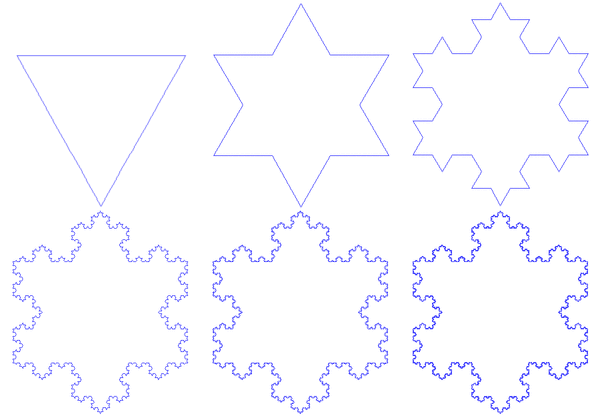
 Development and growth of the fractal demonstrate the ( money and Keynesian) Multiplier. The (Keynesian) Multiplier shows how an initial injection of expenditure into an economic system creates more income. This is because added expenditure sets off additional rounds of expenditure with each and every hand or round this income passes. This principle of 'multiplying' the initial injection can be demonstrated by using the fractal. In the diagram below, income is represented by each triangle's area, and the spending rounds by every iteration of the rule.     The initial injection (iteration 1) is represented by the first triangle, which has an arbitrary area of 1. The next round adds 3 extra triangles, increasing the total area of the snowflake. This (principle) process continues until the changes in the area of the triangle—after each iteration—no longer change the total area of the snowflake. In the diagram above, the total area reaches 1.6  at ar...

The Paradox of Value, fractal

Image
The paradox of value or the diamond water paradox is well established, and it is not my intent to challenge it but rather show that the fractal complements it—explains it. As I have shown earlier, the demand curve is derived from the fractal. It follows that if there is any substance of truth to my thinking, it must address the likes of this paradox, too. The answer to this paradox of value is that diamonds are valued highly because they are assumed to be scarce. They have a low Total Utility and a high Marginal Utility (or value). Goods similar to this are positioned to the left of any Marginal analysis diagram. Water is less valued than diamonds because  it is (assumed) abundant. Water has a high total utility and low marginal utility. The fractal explains this paradox - or at least demonstrates it.   If the object is not developed fractally speaking, it is positioned to the elastic left end of the fractal MA curve in Fig. 1: another iteration will return a...

Universal ceteris paribus: fractal

Image
Ceteris Paribus - keeping all other factors equal or constant. Fractal Isolation This entry shows that fractals demonstrate that Ceteris Paribus exists in reality and has connections directly to our understanding of reality—even possibly at the atomic scale.   Ceteris Paribus  is a central assumption behind economic models and analysis—and, of course, unbeknown to others, all science itself. It assumes or sets all other factors equal or constant, allowing us to study the pattern of the object in question. Without it, the 'cause' and the 'effect' would not be discernible—or would be confused in the 'chaos'. I often explain to those outside economics that this is our way of achieving a controlled laboratory experiment. This is also seen as the weakness of economics, as we don't (really) live in a 'ceteris paribus' world; we live in chaos. I would strongly argue—again—that this is the weakness of all the 'sciences'. We may have theories, ...

1.2a Negative Marginal Utility is misattributed

Image
This entry is an addition to my earlier work on fractal marginal utility, something I have been reluctant to add due to the consequences of such a statement. I am convinced that negative marginal utility is misattributed: the MU curve does not go negative, as shown below. Wikipedia. The fractal shows us that production and benefit are never separated; you cannot have one without the other. The increasing marginal cost (MC) after fractal equilibrium (green in Fig. 2 and 2b below) is more than enough to account for this 'negative marginal utility'. The cost rises - greater than the satisfaction or benefit  -after fractal equilibrium: this is the feeling of being ill after excess consumption, of having had too much of something.

paradigm: fractal

Image
I put it out there, paradigms are a fractal phenomenon. This insight is only a day old (2011-09-02): It was inspired by talking to one of my students. Last year, I saw that she (not knowing it) drew or doodled Sierpinski fractals (below) in the corner of her workbooks, and I thought it was pretty cool. I pointed out to her  - at the time - that she could only draw down to 7 plus or minus 2 different triangle sizes in one doodle. Yesterday, she returned to me and questioned me again on this: Is that the limit? 7?   I explained that 7 plus or minus 2 at one standing, view, or perspective, but if we zoom in, we will see more and more - as they come into focus, but there will always be 7 - yes. Later, it came to me that this standing or perspective is a paradigm, as demonstrated by the fractal development below. The paradigm is the view from the first iteration to fractal equilibrium. A change in paradigm comes with ...

Fractal (Information) Decay

Image
Fractal Decay As shown in the animation below and described in my earlier entries, the fractal demonstrates development and growth, but if this is reversed, it also demonstrates decay. It develops from the first simple iteration to the complex and, in reverse, decays from the complex to the simple, from the snowflake to the triangle. fractal growth and development Analysis Below are two diagrams that analyse the Koch Snowflake fractal: the top diagram shows the exponential, and the lower the log. Both are split vertically (with a 'black' line of reflection), showing development on the left side and decay on the right side. Keep your eye on the snowflake.  The blue curve  shows the extra benefit of another iteration (in terms of Area), and  green - the extra cost of producing or iterating.  As fractal development is exponential, it follows that so is decay. The above diagram...

The credit card effect

The credit card effect (as opposed to 'the butterfly effect') - one person's (credit card) debt could bankrupt a country - or even the world's economy. This is the perfect economic fractal example of dangerous massive debt burdens migrating from the small scale (individual) to the large scale (country);  the principle or idea (of debt) is the same, and the scale is irrelevant. I explained the world's economic problems to my 10-year-old daughter by reducing the problem to her scale—it was very easy. Today, through the mechanism of (moral hazard) bank bailouts, countries are being  burdened. Where to next? This is the perfect storm. '

Object: transformation, formation, creation

Image
From a triangle to the formation of a snowflake, this is a (universal) demonstration of creation: transformation, the creation of an object. Many to make one. Emergence Q. Is the original triangle the big bang? Animation of Koch Snowflake development

Fractal Elasticity along the straight line curve.

Image
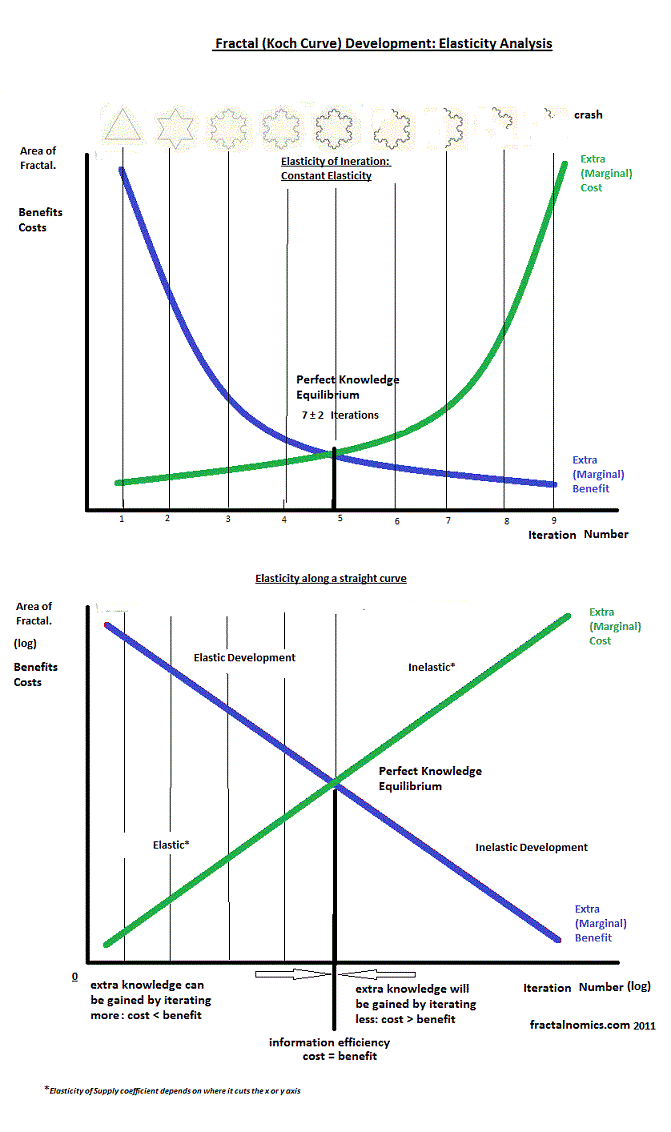
Fractal Elasticity - along the straight line curve. Click to see the most recent developments that complement this entry. After discovering in my early blog that the elasticity of the Koch Snowflake fractal  is constant, I have since pondered what the meaning of all this is. Economic theory suggests that all objects have constant elasticity or are logarithmic in nature. The next step is to straighten out the fractal curves. I produced the following diagrams to do just that and to demonstrate the change in fractal elasticity as the fractal developments. The above diagram shows constant elasticity and the below variable elasticity along the straight (log) curve.

(Christmas) tree Lorenz Curve

Image
After completing my  Lorenz analysis of the Koch Snowflake fractal , I set about analysing a real-life fractal and chose a Christmas tree. This has been a side interest from my core fractal work and thinking, so I have not written it up as a 'science report'. I don't know which species of tree I selected, but it is a typical conifer of the northern hemisphere. Method I trimmed all the branches off the tree, counted them, weighed them, recorded results, then ranked the branches from lightest to heaviest, completed a cumulative percentage rank of weight and count table, and finally graphed the results. Branches everywhere: Below is the Christmas tree Lorenz Curve in terms of weight. Note that 'cumulative percentage of triangle weight' should read branch rather than a triangle. I found that there were 5 levels of branches. I will be honest with you. I did not continue counting and weighing the branches in detail after the third level—the time ...

Rationality and Chaos

Updated: 29th Nov. 2012 This is an entry I have wanted to do for some time. It is the first of three fractal insights I have discovered into economic assumptions (rationality, ceteris paribus, and perfect knowledge). This is a very difficult subject to describe; I hope I give it justice. Understanding rationality is closely related to—if not the same as—understanding 'chaos': that is, complex systems are unpredictable. If we are to understand rationality, then we should understand chaos and, thus, fractals. The definition of the fractal (attractor) is: same but different , at all scales. In our Economic models, we use the assumption ceteris paribus: we hold all other variables constant and treat all persons as rational to see the order (or the 'same', as in the definition) amongst complexity - just as other sciences do.  This definition may be adapted or interpreted in this context of rationality to read as rational but irrational at all scales. This is to say that ...

Fractal Monopoly vs Perfect Competition or Knowledge

Image
Fractal analysis demonstrates  Information asymmetry :  Monopoly and Perfect Competition The diagram below shows the development of the fractal Koch Snowflake. Shape equilibrium (Perfect Knowledge) - but not absolute information as the fractal is infinite in detail or size - is reached at iteration 4 -  where the marginal benefit equals marginal cost.  Perfect Knowledge or ‘perfect information'  is achieved only with free, open, competitive, or unobstructed feedback. Any obstruction to 'iteration' in achieving this equilibrium—due to what may be termed a knowledge monopoly—will produce an incomplete fractal shape, imperfect knowledge, and asymmetric information. At some stage in the future, when things calm down, I plan to come back to this entry and update and further explain it: there is just so much to do.

Evolution and the fractal

Image
Evolution and the fractal Many references from leading biologists and mathematicians suggest that evolution has (often) found fractal ways or has used fractal ways.  This is totally misleading. Evolution is a feature of the fractal. Evolution is always, and everywhere, fractal.   Dictionary Search Results ev·o·lu·tion noun  /ËŒevəˈlo͞oSHÉ™n/  evolutions, plural The process by which different kinds of living organisms are thought to have developed and diversified from earlier forms during the history of the earth The gradual development of something, esp. from a simple to a more complex form - the forms of written languages undergo constant  evolution Synonyms noun:  development ,  growth ,  progress If evolution is defined as change through time and  fractality: as the ' same' but 'different' - at all scales Then, evolution is a (universal) fractal process, and it can be demonstrated in the ...

Macro and Micro and the Fractal

Image
Updated 29th Nov 2012 There are many insights - in relation to macro/micro - that can be taken from the fractal. Firstly, and importantly, when viewing a fractal (in isolation) scale cannot be discerned, the object maybe any size at all, from infinity small to infinitly large; the object shares the fractal charactoristic of being 'same' but 'different' at every scale. The object's shape can be discerned, and from this, an attempt can be made to deduce an understanding of the process to produce it. The object is the 'same'; the examples are infinitely 'different'. Examples: income, wealth, trade, selection, reproduction, specialisation and so on. We see the same but different - at all scales. These principles repeat throughout the universe and are central to biology, chemistry, and physics. This observation sheds light on whether there is a distinction between micro and macro: the fractal shows us that there may be no real separation between th...

Fractal Long Run Short Run

Image
The fractal demonstrates the economic short-run and the long-run In line with the classical economic view of the short run and the long run - best demonstrated by images of  cost curves - the fractal is the math of the said phenomena. Short Run: The development and growth of the fractal from iteration 1 to the equilibrium iteration is the fractal (economic) Short Run. The Short Run is the effect of the starting rule, e.g., branching or adding triangles. The Long Run: The Long Run is the end state, the total superposition, where all the infinite possibilities are shown: the state where the equilibrium iteration shape is set—to the fully developed tree or snowflake.