Posts

Showing posts with the label Fractal Cosmology

Curse of dyslexia; re-edit of my papers

 Curse of dyslexia; re-edit of my papers Can I share with you my personal story, one that culminated with the re-edit of my very special papers on the fractal, quantum, and cosmology?  These days, as I am writing my book, I am making use of a kind of artificial intelligence, in the form of an assistant editor, Grammarly. It's just a breakthrough for me; all my life, I've been cursed with dyslexia. I only learnt that word when I became a teacher. Yes, I'm a teacher, and I know how to read and write, but I have serious issues with it and have had problems in the past. With Grammarly, I have been editing my old work and even this blog. And it's been a great feeling doing this. However, last week I did something that threw me into a pit of humiliation: I looked over the papers I submitted to the International Journal of Quantum Foundations and found them riddled with grammatical errors. What to do? To cut a long story short, I wrote to the editor and said to him that they a...

Macdonalds Law: Increasing cosmological constant with time, a property of an expanding fractal

Image
Cosmic Increasing Acceleration of Cosmological Constant or Dark Energy with Time Explained by the Fractal Update 2025 10 06 I spent the last two days reviewing the commentary on the changing cosmological constant and examining the papers. As a consequence, I would like to retract my previous update, as it is incorrect. My original post remains correct, to the best of my knowledge. The more I examine it, the more it aligns precisely with my model's predictions. What am I to do? Maybe I need to write another short paper bringing these two 'things' together.  View from 10:00 minutes. View from 21:00 minutes Update 2025 09 29 I would like to update what I have written below, as I may have it incorrect. It looks like it's the opposite, actually. Sadly for me, the rate of change is greater now than it was in the past, and that is what it's been saying along, and I misinterpreted that. The one thing I can take from this is a look at my own character. When I saw it, I had m...

The Multiverse must be true.

 The Multiverse must be true.  Last night, while listening to an audiobook on physics and the topic of the Multiverse, I realized that the Multiverse may well be true. Up until this point, I had thought it was just absolute nonsense, a little bit woo-woo, something that is not useful, and, like they all say, out of the reach of the scientific method. But then it had me thinking, and very quickly, I came to the conclusion that why not? My thinking at the time went something like this: what if I were so isolated that all there was was me, what would I be thinking about my origins? I would have no information to know that my story is the story we know now, the human story, the life story, the story of life on Earth. So are we in that room when it comes to the universe, the Big Bang universe? Already, the universe is far older than I led to believe it is, and what if it is just a node, a branch on this? I pause to say it is an infinite tree. I'll stop there because it is a little...

Response to Paul Sutter: Is the universe a fractal? Yes it is!

 In response to Paul Sutter's,  Is the Universe a Fractal?  Yes, it is. His response is lazy and outdated. It is Clickbait. I am not saying this because I just wanted to; I am because I've tested it; I've modelled the growth of a fractal, and the fractal is the best fit. I wonder if any other person has done that, modelled a geometry to the movements of the universe?  Put another way, if you model the growth of a fractal, which I have, the universe's evolution is precisely what you would expect to see. The distribution of galaxies is exactly what you expect to see. By my modelling, the large, smooth structure of the observable universe — the space that the sceptics of fractal cosmology point to as evidence of a breakdown in the theory — is the trunk of a fractal structure. All fractals have this hierarchical structure. Look at a tree, and I have modelled tree growth too; the trunk is the majority of the area of a tree, and that trunk is the smooth outer universe that...

Big Bang Age of Universe Really an Absolute Time Dilation, Time Barrier: An Illusion

Here, I introduce my theory, which explains the age of galaxies at the edge of the observable universe. Based on the mechanics of special relativity and time dilation, I think we are witnessing a time barrier.  The Standard Model Big Bang Age of the Universe Confused for Special Relativity Absolute Time Dilation Barrier You'd think that when you go on holiday, you should stop thinking for a while about 'the big questions' and take a break. Well, not me. In fact, I think even more, lol. I love it. The Problem One of the biggest problems I have—(it is not the only one, lol)—and many of you will know about it because I talk about it so much—is the age of the universe and why it is so young compared to the age of the Earth or the solar system. It is 13.8 billion in relation to our 4 to 5-ish billion years. In terms of geological Earth, where we talk about 'deep time', there is no time for deep time in the universe. Why is the universe so young?! Add to this the discover...

Letter to Fractal Cosmology Opponent Hogg

Image
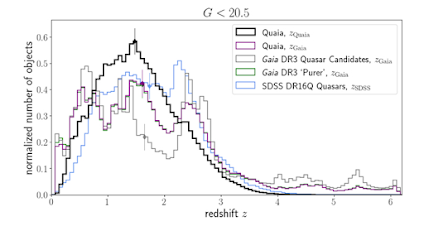
 This is the letter I wrote to Professor David Hogg, the opponent of Fractal Cosmology.  Please see my posts 'Fractal Cosmology' and Letter to Fractal Cosmology Opponent Hogg , share this, and read my papers. Thank you.  Subject:   Quaia catalogue corresponding with transitions in a physical inhomogeneous fractal model Dear Professor Hogg,  Firstly, congratulations on your recent Quaia Quasar catalogue. I believe it, along with DESI, is one of the greatest achievements of all time. My name is Blair Macdonald. Ordinarily, I would have no business with you as I am not a cosmologist; however,  what  I have found should interest you all.   I have tried to make this as short and as simple as I can. Being it what it is, this is a complex. Bear with me, please. In short: I have published a model that corresponds to your observations: it is the fractal. This is why this email is directed to Professor Hogg. I have taken fractals beyond the Italian fra...

Fractal Branch Distribution Experiment Corresponds with Universe Galaxy Distribution.

Image
  The following continues my work on fractal cosmology. To access my papers and developments, look back to my recent posts over the last year.  I experimented on a tree to see if the fractal corresponds with galaxy distribution from the latest galaxy survey.  Introduction The recent Gaia telescope Quaia survey of the universe produced a galaxy distribution diagram (Figure 1) that shows an uneven distribution of galaxies with distance.  3D map of over 1 million black holes traces where the universe's dark matter lies. Figure 1. Galaxy distribution diagram (Figure 11) from the paper: Quaia, the Gaia-unWISE Quasar Catalog: An All-sky Spectroscopic Quasar Sample, Hogg and others   https://iopscience.iop.org/article/10.3847/1538-4357/ad1328 This diagram offers an opportunity to test whether this universe distribution shape corresponds with the distribution from a fractal tree. If so, the observation location may be inferred. The rise from the origin, 0 dist...

Fractal Cosmology David Hogg Letter

Image
Just so you know, a week or two ago, I sent what might have been the most important email of my life. In March, I saw that the results of a recent large-scale universe quasar survey corresponded directly with my fractal model of the universe and that one of the authors of this survey/paper is the key opponent to fractal cosmology, Professor David W. Hogg of New York University. I had to respond, and I have. This is some background from New Scientist Magazine 2007: 'Hogg's team feel that until there's a theory to explain why the galaxy clustering is fractal, there's no point in taking it seriously. "My view is that there's no reason to even contemplate a fractal structure for the universe until there is a physical fractal model," says Hogg. "Until there's an inhomogeneous fractal model to test, it's like tilting at windmills." In my email, I have shown him and all the authors (why not!) that I have that model, and it is described in the ...

New Fractal Interpretation of Quantum Mechanics

I am writing a letter to the Nobel Laureate, John Clauser, explaining to him what I have published on fractal and quantum mechanics. For the first time, I may have written a totally new quantum interpretation. I had never thought of that before.  My fractal interpretation  of quantum mechanics covers all the other interpretations and more — it links quantum mechanics to cosmology. They are inextricably linked. I have not heard a word back from anyone.  My papers: International Journal of Quantum Foundations, Speculations. The Fractal Corresponds with Lig ht a nd Foundational Quantum Problems https://ijqf.org/archives/6806 ). Experiment on Inverted Fractal Corresponds with Cosmological Observations and Conjectures https://ijqf.org/archives/7011 What is a Quantum Interpretation?  This is from  The Internet Encyclopedia of Philosophy Interpretations of Quantum Mechanics Quantum mechanics is a physical theory developed in the 1920s to account for the behaviour of ma...

Response to Sabine Hossenfelder Big Ring Galaxies

Image
This post is in response to Sabine Hossenfelder's clip (below) Astrophysicists Find Big Ring of Galaxies that Should Not Exist .   I wrote the following in the comments. Sadly, it appears to be shadow-banned.  " This is key evidence that the universe is a fractal to me. I have modelled a (growing) fractal from the perspective of an observer within one. My model produces Hubble (diagram) expansion that is accelerating with time from a point beginning. Points on the fractal recede away just as galaxies are observed by astronomers. The model also predicts these large structures, what I call the boughs of the fractal. The CMB is the trunk. We are in the clustered and super-clustered branches of the fractal shape. Last week, my work was published in The International Journal of Quantum Foundations, and 8 months ago, I published in the same journal on how the fractal shares problems known as the quantum. The astronomical observations and the quantum problems are two aspects of ...

Second Paper Published Unifying Cosmos and the Quantum with the Fractal

Experiment on Inverted Fractal Corresponds with Cosmological Observations and Conjectures https://ijqf.org/archives/7011 In around nine months, I have had my second paper accepted by the International Journal of Quantum Foundations, this one on Fractal Cosmology. My first was on the Fractal and Quantum problems. Although these are not peer-reviewed, they are my original ideas and experiments, and they are now crystallised in a journal article.  What response will I get from these? The two papers go together. It has been around 26 years of thinking and working towards this. The fractal is 'the bridge' between the quantum and the cosmos. My work does not yield any insights into gravity, though it may have something to say about 'dark matter'. I will proceed with this only if I receive encouragement to do so. It is time to move on to other things.  See my early post on the submission of this paper.  Fractal Cosmology Paper Unifying Theory Submitted  

Dark matter may be explained by fractal geometry

  Lately, I have been pondering about galaxies, their rotation speed, the concept of 'dark matter' associated with them, and the fractal. I decided to revisit this topic. After examining my fractal cosmology model for several days and studying recent research papers on dark matter and black holes, I now believe that my model can clarify why stars orbit around the galaxy faster as they move further away from the centre, which is known as 'dark matter.' I can deduce that the speed of rotation and the size of the galaxy are directly linked to the size of the black hole, and they become massive as they move further out into the universe. My model suggests acceleration with distance, and it forms a spiral. In addition, recent observations suggest that the universe may be spiralling, which aligns with my model's prediction. Furthermore, black holes are referred to as' singularities,' which is similar to the universe's supposed 'Big Bang' origin, and m...

Fractal Cosmology Paper Unifying Theory Submitted

Image
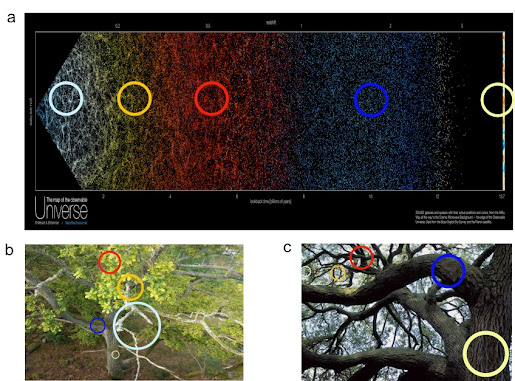
  "Dear Dr Macdonald, We have received your article "In Situ Experiment on a Fractal Corresponds with Cosmological Observations and Conjectures". We will consider it for possible publication in International Journal of Quantum Foundations . https://ijqf.org/archives/6806 Thank you for submitting your work to this journal." Last night, I submitted my second paper on the same (fractal) geometry to the same journal. (Again, I do not hold a PhD). (giggle) In this paper, I wrote up a model/experiment showing what you would expect to see if you were in a growing fractal and show this view corresponds (exactly! give or take the effects of gravity) with cosmological observations. It is as if we are in the branches of a large tree (images b and c), surrounded by branches, looking down and out to the bigger branches, the boughs, and then the trunk - that was once the seedling. Trees are a perfect example of a fractal (which incidentally all grow exponentially with age). This ...

DESI Challenging My Fractal Cosmology Theory

Image
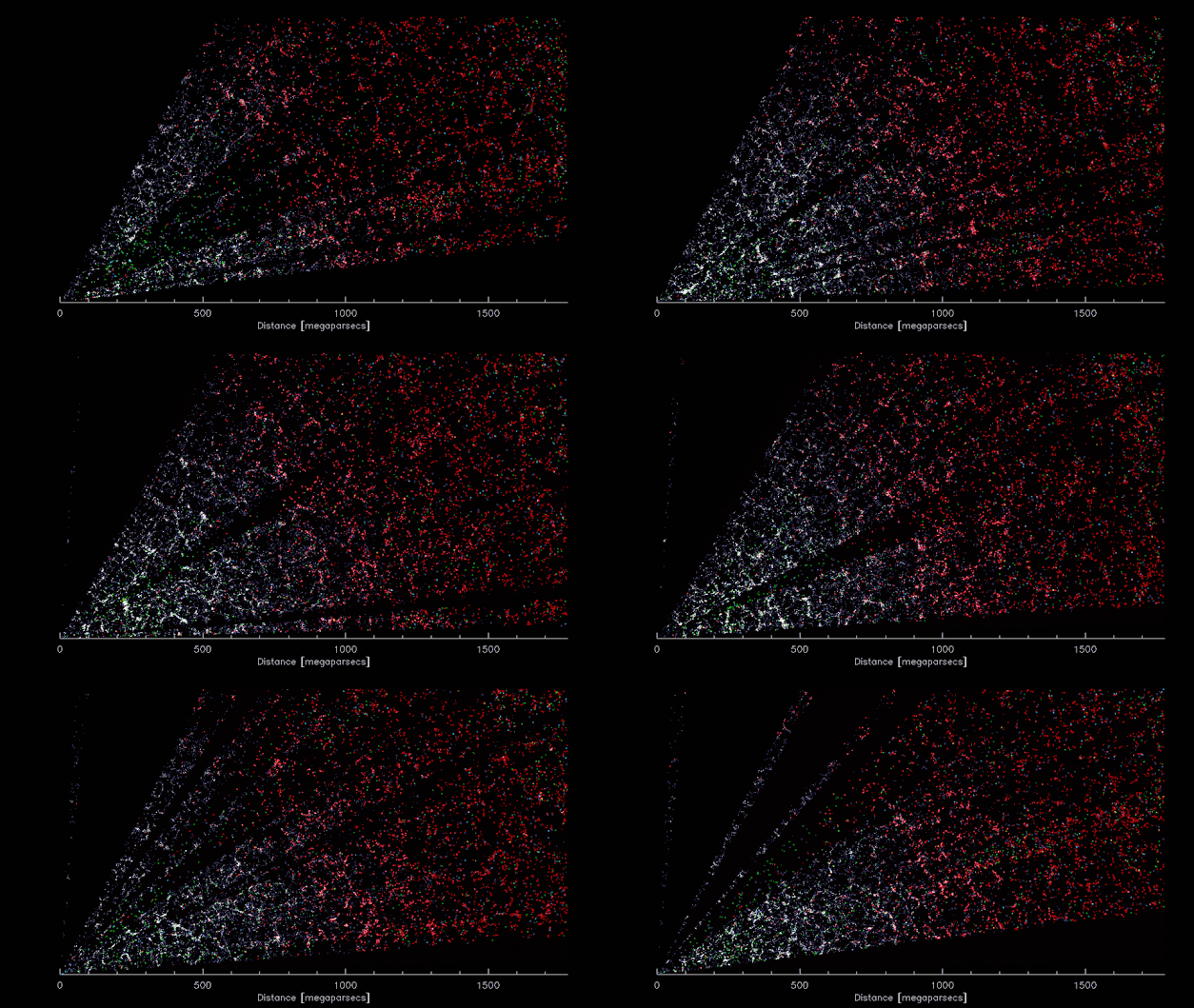
When I saw this in my feeds on Thursday, it stopped me in my tracks (stop the train!!) and has since made me think—wow! This is epic. A detailed picture looking halfway across the observable universe. It does not look suitable for (my) fractal theory, but it is still in the early days, and they are pulling in the (old) quasars out there. We'll see how it looks when they are finished. The survey before this one took us out to around 100 (on the x-axis) and was the scale on which we fractalists based our work. I/we have been predicting larger and larger galaxy structures the further out we look. They don't seem to be there. mm... or? https://newscenter.lbl.gov/2022/01/13/dark-energy-spectroscopic-instrument-desi-creates-largest-3d-map-of-the-cosmos/

Giant Arc evidence of a fractal universe

Image
I'm looking at my feeds, and I see astronomers have discovered (or finally recognised; we've known about them for years) that there is a 'large' structure at the outer edges of the universe. 3 billion years wide, 'Giant Arc'. https://www.sciencetimes.com/.../could-this-3-billion... This blows apart the standard model of cosmology as for it galaxy distribution is smooth on all scales. But a few have challenged this view and said the universe is fractal - fractal-cosmology. I came into this from the outside, indirectly. The universe is recognised 'by science' as being fractal on small scales (out to around 1 billion years), but on large scales, it is smooth and assumed not fractal. No, it is not smooth, and nor should it be. I have taken fractal cosmology further by modelling a fractal (doing the maths directly from a fractal, an experiment). Big structures like the Giant Arc are exactly what we would expect to see—like big branches on a tree near the trun...