Posts

Fractal (Information) Decay

Image
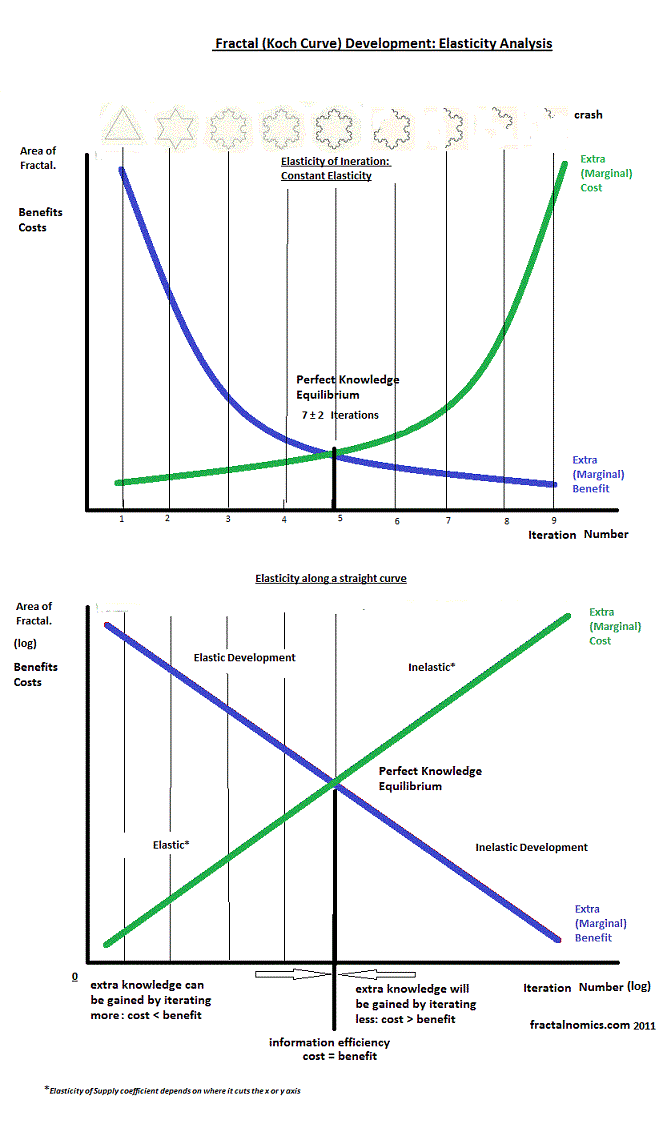
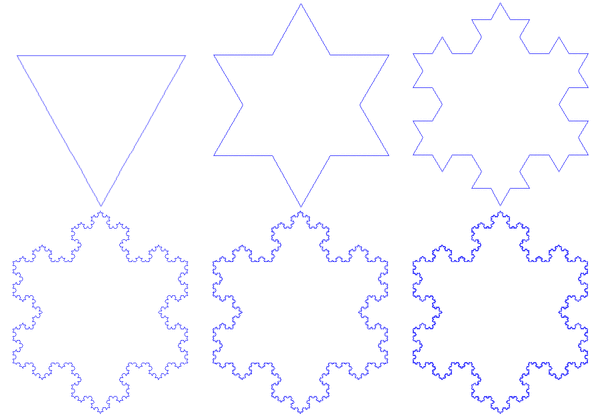
Fractal Decay As shown in the animation below and described in my earlier entries, the fractal demonstrates development and growth, but if this is reversed, it also demonstrates decay. It develops from the first simple iteration to the complex and, in reverse, decays from the complex to the simple, from the snowflake to the triangle. fractal growth and development Analysis Below are two diagrams that analyse the Koch Snowflake fractal: the top diagram shows the exponential, and the lower the log. Both are split vertically (with a 'black' line of reflection), showing development on the left side and decay on the right side. Keep your eye on the snowflake.  The blue curve  shows the extra benefit of another iteration (in terms of Area), and  green - the extra cost of producing or iterating.  As fractal development is exponential, it follows that so is decay. The above diagram...
The credit card effect

The credit card effect (as opposed to 'the butterfly effect') - one person's (credit card) debt could bankrupt a country - or even the world's economy. This is the perfect economic fractal example of dangerous massive debt burdens migrating from the small scale (individual) to the large scale (country);  the principle or idea (of debt) is the same, and the scale is irrelevant. I explained the world's economic problems to my 10-year-old daughter by reducing the problem to her scale—it was very easy. Today, through the mechanism of (moral hazard) bank bailouts, countries are being  burdened. Where to next? This is the perfect storm. '

Object: transformation, formation, creation

Image
From a triangle to the formation of a snowflake, this is a (universal) demonstration of creation: transformation, the creation of an object. Many to make one. Emergence Q. Is the original triangle the big bang? Animation of Koch Snowflake development

Fractal Elasticity along the straight line curve.

Image
Fractal Elasticity - along the straight line curve. Click to see the most recent developments that complement this entry. After discovering in my early blog that the elasticity of the Koch Snowflake fractal  is constant, I have since pondered what the meaning of all this is. Economic theory suggests that all objects have constant elasticity or are logarithmic in nature. The next step is to straighten out the fractal curves. I produced the following diagrams to do just that and to demonstrate the change in fractal elasticity as the fractal developments. The above diagram shows constant elasticity and the below variable elasticity along the straight (log) curve.

(Christmas) tree Lorenz Curve

Image
After completing my  Lorenz analysis of the Koch Snowflake fractal , I set about analysing a real-life fractal and chose a Christmas tree. This has been a side interest from my core fractal work and thinking, so I have not written it up as a 'science report'. I don't know which species of tree I selected, but it is a typical conifer of the northern hemisphere. Method I trimmed all the branches off the tree, counted them, weighed them, recorded results, then ranked the branches from lightest to heaviest, completed a cumulative percentage rank of weight and count table, and finally graphed the results. Branches everywhere: Below is the Christmas tree Lorenz Curve in terms of weight. Note that 'cumulative percentage of triangle weight' should read branch rather than a triangle. I found that there were 5 levels of branches. I will be honest with you. I did not continue counting and weighing the branches in detail after the third level—the time ...

1 + 1 does not equal 2

It came to me yesterday - in an epiphany: 1 + 1 does not equal 2: if it does, it is only half the answer; the other half lies in understanding chaos and fractals. The definition of (or insight from) the fractal is the same but different (or regular irregularity) - at all scales. Fractals show us how no two objects are the same; they are complex and  different . The 'same ' component of the definition is quantitative and met or described as the 1 + 1. The different is qualitative and describes (at least) the diversity, complexity or unpredictability of the object. Update 2015 I have long thought about my early entry and now know more. If 2 identical objects are added together, they equal 1. They are indistinguishable. I have also learned this is an assumption at the quantum level where particles are assumed to be identical, which supports my fractal quantum theory. I plan to write all this in one paper as soon as possible. Blair

Rationality and Chaos

Updated: 29th Nov. 2012 This is an entry I have wanted to do for some time. It is the first of three fractal insights I have discovered into economic assumptions (rationality, ceteris paribus, and perfect knowledge). This is a very difficult subject to describe; I hope I give it justice. Understanding rationality is closely related to—if not the same as—understanding 'chaos': that is, complex systems are unpredictable. If we are to understand rationality, then we should understand chaos and, thus, fractals. The definition of the fractal (attractor) is: same but different , at all scales. In our Economic models, we use the assumption ceteris paribus: we hold all other variables constant and treat all persons as rational to see the order (or the 'same', as in the definition) amongst complexity - just as other sciences do.  This definition may be adapted or interpreted in this context of rationality to read as rational but irrational at all scales. This is to say that ...