Posts

Koch Snowflake Area paradox: it's infinite I say.

I disagree that the area of the Koch snowflake is finite, as claimed. The calculation may give the result of a finite number—from a fixed point—but as the system is iterating infinity, as is assumed, the area of each added triangle will be real, and these areas infinitely diminish—asymptotically.  If we zoom into the 'last' iteration area size, where the area becomes finite, we likely see the iteration continuing with this diminishing added area. Infinite Series and Convergence. There is a paradox here, a practical result conflicting with a calculated result. In reality, it is both: these infinite series must go on (converging), presenting ever-diminishing values, and thus, the 'limit' must be irrational, not finite. But I will not challenge the finite calculation; I do not have the authority or ability to do that.  Interesting.
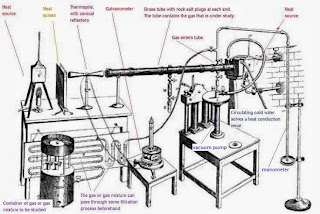
Debunking Greenhouse Theory Physics

Image
I have now published my updated theory of the atmosphere.  Augmenting 19th Century Thermoelectric Greenhouse Theory with 20th Century Quantum Mechanics Raman Spectroscopy: Towards a Coherent Radiation Theory of the Atmosphere Debunking Greenhouse Theory Physics The Gassy Messenger. Abstract Modern climate science's fundamental premise (or assumption) is that greenhouse gases (around 2% of the atmosphere) absorb radiant infrared (IR) heat (as derived by IR spectroscopy) and are the main climate driver because of this speciality. This premise originates with the  John Tyndall 1859 thermopile infrared detection experiment . The (other)  non-greenhouse  gases  (N 2  nitrogen and O 2  oxygen)  are distinguished from the  greenhouse  gases by their (said * ) inability to absorb (infrared) heat, as deduced from the same experiment: here, absorption is confused with opacity.   Raman spectroscopy (a complement to ...

I picked the 2008 financial market crash.

Image
In response to hearing 'economists didn't pick the crash', I did . In 2004, I was teaching economics when I saw and recorded this program (below). I would show it to my students and spend the next four years being very unpopular with my friends and family, saying it's going to slide and the global economy will go with it. They would laugh at me. I am quite proud of that now. At the time, I had never heard of Austrian Economics, Peter Schiff, or Michael Burry. I argued that the crash was caused by the property wealth effect (illusion) and the elasticity of goods in the developed world: if the 'wealth' bubble popped, the elastic goods would dry up, and it would be over. Mortgage Madness (1/3): BBC2 - 29/10/2003    There is not a moment I don't think about the real slide coming. My current students don't know about 2008 where I live in Sweden, it was paved over; so I have to teach it as a kind of history lesson. And the current property market is ...

To Professor Brian Cox on Facebook on Contradictions

Image
I have now published my updated theory of the atmosphere. Quantum Mechanics and Raman Spectroscopy Refute Greenhouse Theory and The Greenhouse Gases and Infrared Radiation Misconceived by Thermoelectric Transducers I have placed the following comment on Professor Brian Cox's Facebook sight in response to the following clip; I look forward to review and or feedback. Professor Cox, yes, those laws 'repeat all over the universe', but there are two gaseous molecules that - by 'our' understanding of greenhouse theory - contradict these laws, nitrogen and oxygen - together making up some 99% of Earth's atmosphere. In gre enhouse theory, N2 and O2 are assumed, as if by law, not to absorb or emit radiation, but this, if true, is in violation of both thermodynamics and quantum mechanics where everything above absolute zero and with spectra lines (vibration modes) vibrates and radiates; but conversely, if found wrong of mistaken, would pose a violation of greenho...

Lorenz Curve of the Universe's Elements

Image
Lorenz Curve of the Universe's Elements Update May 2017 I have published a working paper on the Lorenz curve being a fractal property at academia.edu . Abstract Global income has increased exponentially over the last two hundred years; while, at the same time, respective Gini coefficients have also increased, this investigation tested whether this pattern is a property of the mathematical geometry termed a fractal attractor. The Koch Snowflake fractal was selected and inverted to best model economic production and growth: all triangle area sizes in the fractal grew with iteration time from an arbitrary size – growing the total set. The area of the triangle, the ‘bits’, represented wealth. Kinematic analysis – velocity and acceleration – was undertaken, and it was noted growing triangles propagate in a sinusoidal spiral. Using Lorenz curve and Gini methods, bit size distribution – for each iteration-time – was graphed. The curves produced matched the regular Lorenz curve...

THE FULL COMPLEMENT OF GREENHOUSE GASES

Image
I have now published my theory of the atmosphere.  Augmenting 19th Century Thermoelectric Greenhouse Theory with 20th Century Quantum Mechanics Raman Spectroscopy: Towards a Coherent Radiation Theory of the Atmosphere THE FULL COMPLEMENT OF GREENHOUSE GASES This is a diagram of all the vibrational modes ('absorption bands') of the Earth's atmospheric gases; in the near-infrared range of the electromagnetic spectrum. Gases are detected by thermoelectric thermopile or bolometer detectors (below), 'what is incorrectly termed 'IR spectroscopy'; and by thermoelectric's complement, Raman (Laser Lidar) spectroscopy (above). Notice that O2 and N2 (some 99% of the dry atmosphere) are only detected using Raman spectroscopy. This is due to their one (and only) vibrational mode being non-thermoelectric: they both have only symmetric vibrational modes, with no electric dipole moments to generate an electric charge by the thermopile and so are not transduced and ...

The Albedo-Emissivity Paradox

I would like to share with you a paradox I uncovered during my investigation into thermoelectrics ('IR spectroscopy'): the albedo-emissivity paradox.  Snow's albedo is very high as it reflects light, while its emissivity is also very high (near 1, which implies it absorbs and emits IR radiation and does not reflect IR (thermal) radiation). Snow and ice are near-perfect black bodies. But does snow really not reflect IR (heat)? In any other context, IR is thermal radiation and is related to heat and temperature. Snow absorbs this IR but does not reflect it? Can this be true? I don't think so. Black-painted or dyed snow will melt faster than white pure snow.  No one has discussed this paradox.  Where have I - or scientists gone wrong?  I have a possible answer to this, and the clew is aluminium and other shiny metals - all of which have low emissivities - next to 0. Different materials don't have such low emissivities: not water and not snow - they have high ...